What we fix
A Wolf range that clicks, drifts off temperature or goes dark
Dual-fuel, all-gas and induction ranges. Burners that will not catch, ovens that drift off their setting, and boards that stopped answering after a storm.
What it usually looks like
- A surface burner clicks and clicks but never catches
- One burner lights, the others only spark
- The oven runs hot or cold against an oven thermometer
- The oven ignites, then drops out a few minutes later
- The display is dark or frozen the morning after a storm
- A knob turns but nothing under it responds
- The convection fan rattles or stops turning
- The oven door will not close square against the frame
A range is the appliance a kitchen gets planned around, which is why a house feels broken when one stops. Almost everything we are called out for falls into four groups, and none of them needs guesswork to identify.
Burners that spark but will not light
Continuous clicking with no flame is the most common call of the year. On most spark-ignition ranges every electrode fires when any single knob is turned, so the pattern tells you where to look before a tool comes out of the bag. If every position clicks and only one burner stays dark, the module is answering and the fault is at that burner: a cracked ceramic insulator on the electrode, a burner cap seated a millimetre proud of its base, or a port ring still holding the water from the last clean.
If nothing clicks at all, the question moves upstream to the switch stack, the harness and the module itself. We check for spark at the electrode before condemning anything, because a module is a part and a wet burner cap is a towel.
A burner that lights but burns lazy and yellow is a different fault again. That is a fuel-and-air problem — a partially blocked port, a spider web in an orifice after a summer outdoors, or a range set up for the wrong gas. Fleming Island is mostly natural gas or propane depending on the street, and a conversion done without changing every orifice will show itself in the flame colour long before anything fails.
Ovens that will not hold their setting
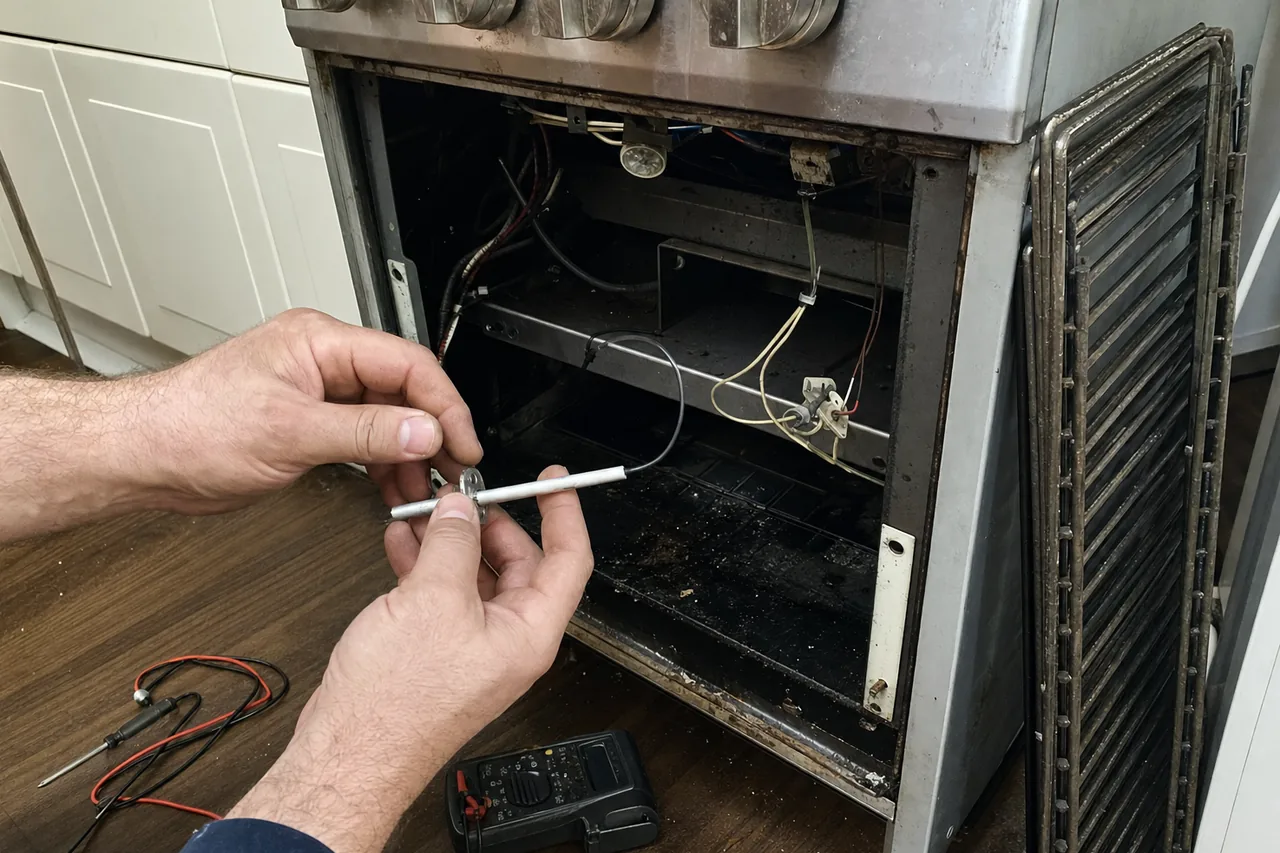
An oven that browns unevenly or runs twenty degrees off is usually reporting a temperature sensor that has aged out of range, not an element that has failed. The sensor is a resistance probe: its resistance climbs with temperature along a published curve, so we measure it cold, compare it with the manufacturer’s own figures, and then measure again at temperature. A sensor that reads correctly cold and wanders hot is still a bad sensor.
Only after that do we look at the element, the relay that drives it, and the door seal. A door that has dropped even slightly on its hinges lets enough heat past the gasket to pull the top of the cavity out of balance, and no amount of calibration fixes a hinge.
Boards that stopped answering
North Florida sees roughly 68 thunderstorm days a year, and it is the surge that travels behind a nearby strike that ends a control board, not the strike itself. The morning-after call is always the same shape: the range worked at dinner, there was weather overnight, and now the display is dark or lit but deaf to every touch.
Before we quote a board we test what is feeding it. A failed board on a healthy supply is a parts job. A failed board on a bad supply will be a failed board again inside a month, and saying so is worth more than selling the part twice.
Doors, hinges and the mechanical side
The least glamorous faults are the ones people live with longest. A door that sits crooked, a hinge spring that has lost its tension, a rattling convection fan whose bearing has gone dry, an oven light that fills with moisture. None of them stop the range working. All of them get worse, and all of them are cheaper to correct before they take something else with them.
How the visit runs
A flat diagnostic covers the trip and the time to find the fault properly, including meter readings rather than a guess. It is credited in full toward the repair if you go ahead. You get the estimate in writing before a part is ordered or labour is billed, and the work carries 90 days on labour and 365 days on genuine OEM parts.
We service Wolf cooking appliances only, and we are independent of the manufacturer. That narrowness is deliberate: one brand, one category, and the common failures learned properly rather than approximately.
Before the estimate
What does range work usually come to?
Flat $80 diagnostic covering the visit and the full diagnostic sequence, credited toward the repair once you approve the work. Everything below it is what that class of repair has actually run here, parts and labour together — a range rather than a single number, because the firm figure is only honest once the fault has been measured.
| What was wrong | Usual total |
|---|---|
| $80 diagnostic visit | $80 |
| Convection fan or motor | $260–$700 |
| Igniter or spark module replacement | $210–$540 |
| Burner valve or orifice service | $210–$650 |
| Control board or touch panel | $430–$1,070 |
Ranges, not quotes. Which band a job lands in depends on the part and on how much has to come apart to reach it, and that is settled by the diagnostic rather than by the telephone. The written estimate carries one figure and a lead time, and nothing is ordered until you have agreed to it.
Asked on the telephone
Why does the burner click and click without lighting?
On most spark-ignition ranges one module fires every electrode when any knob turns, so the pattern narrows it before a tool comes out of the bag. Every position clicking with one burner dark points at that burner: a cracked insulator, a cap sitting proud or wet, a blocked port. A single dead position points further back.
Can the oven and the cooktop fail at the same time?
They can, and when they do the supply is the first suspect rather than a coincidence of two parts. A shared circuit, a tired regulator on propane, or a surge that reached the board through the receptacle will take out both halves at once. That is why the meter comes out before the back panel does.
Is an oven that runs off temperature worth repairing?
Usually. Drift is most often a temperature sensor that has crept out of tolerance, and a sensor is an ordinary stock item rather than an ordered one. The table on this page shows where that sits against a control board or a door assembly, and the written estimate carries the figure that applies to yours.
The terms, unchanged
$80 flat diagnostic, credited toward the repair. You get a written estimate before any part is ordered or any labour is billed. Genuine OEM parts, with 90 days on labour, 365 days on parts.
Most parts arrive in two to five business days. Nothing is ordered before you approve a written estimate.