Quiet note
Reading Wolf oven error codes before anyone books a visit
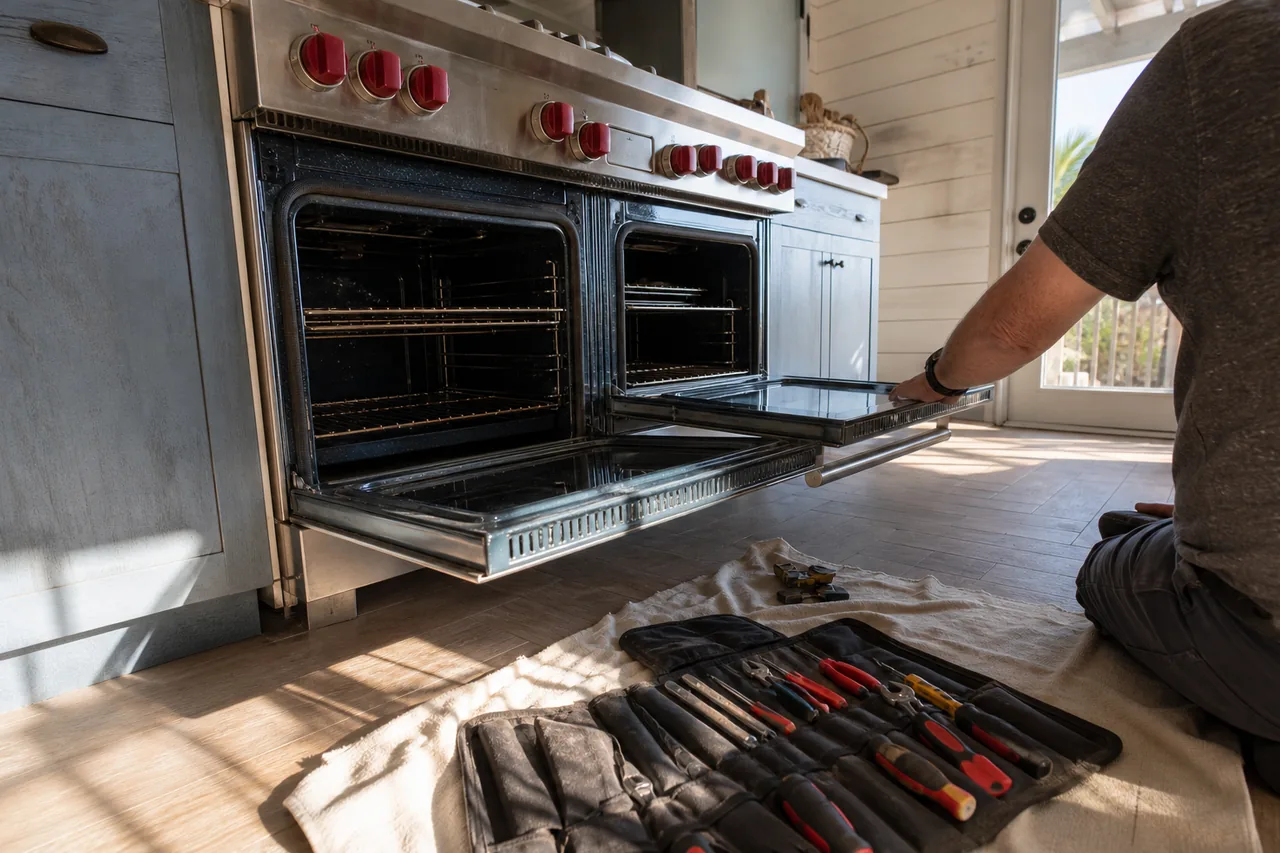
What the codes and messages on a Wolf oven or range mean, which ones an owner can clear with a simple check or a breaker reset, and which ones always mean a service visit.
Wolf oven error codes sort into three groups. Some are plain prompts that vanish once you do what they ask, such as Probe Shorted or the descaling message on a convection steam oven. Some are electronic hiccups that Wolf tells owners to clear by switching the breaker off for 30 seconds. A few, like 3C20 on an M Series oven, mean a technician has to look no matter what you try first. Which group your code belongs to decides whether you walk to the electrical panel or pick up the phone.
If your display shows something not covered below, copy it down exactly, spaces included, and treat it as a service call.
Messages that only want an action from you
Several things a Wolf oven puts on its screen are not faults. They are the control asking for one small step.
- Probe Shorted on an M Series oven: touch Off, push the probe plug fully into its socket on the oven wall, then set the oven temperature and probe temperature again.
- SAb on the oven knob of a dual fuel range: the range is in Sabbath mode. Nothing has failed.
- An error during self-clean on an M Series double oven: while one cavity is cleaning, the other is locked out. Wait for the cycle to end.
- Do Not Remove Water Tank on a convection steam oven: water in the boiler is not pumped away until it cools below 175°F (80°C). Leave the tank alone and let it cool.
- Appliance Blocked, Descaling Necessary: run the descale program. If the message is still there after it finishes, the oven needs service.
- E78 together with F24 on the steam oven touchscreen: pour some water into the drain and clean the drain filter.
Codes a 30-second breaker reset may clear
Oven controls can latch onto a bad reading after a power blip. For several codes Wolf gives the same first step: turn the oven’s circuit breaker off at the panel, wait 30 seconds, turn it back on and test.
That applies to E01 paired with F5 on a convection steam oven, which Wolf links to moisture or electrical interference reaching the control board. It also covers E43 with F8, which means one of the oven’s two neutral relays has stuck, and the M Series message Lower Door Open or Unlocked in Clean. On Fleming Island, a code that turns up the evening after a summer thunderstorm made the lights flicker is the likeliest kind to clear this way; the note on storms and control boards goes further into why.
One reset is the limit. If the same code returns, more power cycling will not mend a failing relay or board.
A flashing light on a gas range
On a Wolf gas range, a blinking oven or griddle indicator light means the flame was lost and the range shut itself into a safety lock-out. Turn the knob off, then back on to relight. If the light starts flashing again, a weak igniter or a gas supply problem is the likely cause, and that is work for a technician.
On a Wolf IR induction range, E 07 (primary too hot), E20 (a heat sink sensor or zone temperature fault) and E40 (a generator sync error) come from the cooktop electronics, and the same 30-second breaker reset is the first step for each. E 05 on the IR30450 and IR36550 means the controls get no answer from the generator, and Wolf lists no owner fix for it.
Codes that always mean a visit
- 3C20 on an M Series oven: the supply voltage coming in is too high. Wolf offers nothing for the owner to try beyond booking service, and the technician will want to measure the supply as well as the oven.
- Any code that comes back after a breaker reset or after descaling.
- A message paired with a scorched smell, or an oven door still latched long after self-clean has ended.
What the visit usually costs
A visit starts with the $80 diagnostic. Once the fault behind the code is confirmed, repairs tend to fall into a typical range: an oven temperature sensor runs $190–$550, a control board or touch panel $430–$1,070, and a door hinge, glass or seal behind a door-lock message $180–$660. The firm figure comes after diagnosis. We work on our own and have no tie to the manufacturer’s service network.
Before calling, note the exact code, the model from the rating tag and whether a reset changed anything. If the oven shows no code but simply will not warm up, the note on an oven that will not heat is the better starting point.
Before the estimate
What would this cost to put right?
Flat $80 diagnostic covering the visit and the full diagnostic sequence, credited toward the repair once you approve the work. Everything below it is what that class of repair has actually run here, parts and labour together — a range rather than a single number, because the firm figure is only honest once the fault has been measured.
| What was wrong | Usual total |
|---|---|
| $80 diagnostic visit | $80 |
| Control board or touch panel | $430–$1,070 |
| Oven thermostat or temperature sensor | $190–$550 |
Ranges, not quotes. Which band a job lands in depends on the part and on how much has to come apart to reach it, and that is settled by the diagnostic rather than by the telephone. The written estimate carries one figure and a lead time, and nothing is ordered until you have agreed to it.