What we fix
A Wolf wall oven or warming drawer that browns unevenly, sticks shut or goes dark
Built-in single and double wall ovens and warming drawers. Uneven browning, a cavity that never reaches temperature, a stuck self-clean latch, a dark panel.
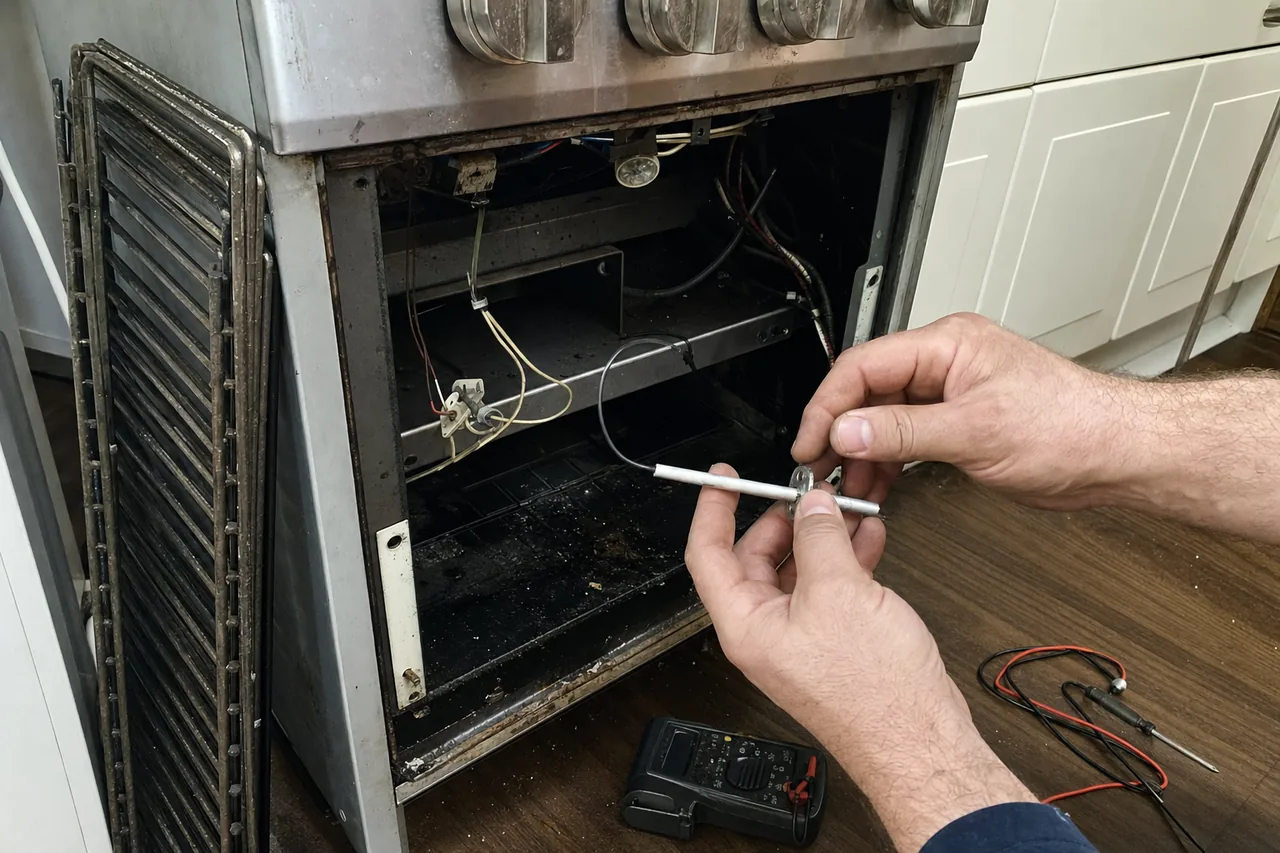
What it usually looks like
- Baking browns on one side and stays pale on the other
- The cavity takes far longer than it used to reach temperature
- The oven quits mid-bake and the panel goes blank
- The door will not unlock after a self-clean cycle
- The door sits crooked or will not shut against the seal
- The cooling fan runs for a very long time after use
- The warming drawer feels barely warm on its highest setting
- The interior light stays on with the door closed
A built-in oven is harder to reach than a range and easier to diagnose, because almost nothing about it is hidden behind a fuel supply. It heats, it senses, it switches, and it seals. When one of those four stops doing its job the symptom usually says which.
Heat that arrives unevenly
Uneven browning is a circulation fault more often than a heating fault. In a convection cavity the fan is supposed to move air past the element and around the food at a rate that flattens the gradient between the top and the bottom of the box. A fan slowed by a dry bearing, a fan whose blade has loosened on the shaft, or a rear baffle refitted a few millimetres out of place after a clean will all produce a cavity that bakes on a slope.
The other frequent cause is the door. Heat escaping past a flattened gasket, or past a door that no longer pulls square because one hinge has lost spring tension, pulls the front of the cavity down while the sensor at the back keeps reporting that everything is fine. You cannot calibrate your way out of a mechanical leak, and we do not try.
A cavity that never gets there
An oven that heats slowly, or stalls short of the set point, is usually a sensor, an element, or the relay that drives the element. The sensor is a resistance probe with a published temperature curve, so it can be measured cold and again hot and compared against the maker’s own table rather than a hunch.
A bake element that has failed open is obvious on a meter and often visible: a blister, a split, or a bright scar where it arced. A relay that has welded or gone high-resistance is less obvious and matters more, because it sits on the board and tells you something about how the appliance has been supplied.
Latches, locks and self-clean
The self-clean cycle asks more of an oven than anything else it does. It runs the cavity far above cooking temperature for hours, which is exactly the condition that finds a tired latch motor, a marginal thermal cut-out or a door switch that was already intermittent. A door that will not release afterwards is nearly always the latch assembly or its microswitch, and it is a repair rather than a replacement of anything expensive.
We are not opposed to self-clean, but we will say plainly that running it the night before a holiday is how a working oven becomes a broken one at the worst possible moment.
Warming drawers
A warming drawer is a low-wattage element, a thermostat or control board, a humidity vent and a seal, and it fails in that order of likelihood. A drawer that feels barely warm at its highest setting is usually an element or its control, not a calibration issue. A drawer that dries everything out has its vent open when the food wanted it closed. Both are quick jobs once the drawer is out.
Getting the oven out at all
Built-ins live in a cabinet that was often finished around them. Trim that has been caulked, flooring laid up to the cabinet base, and a junction box behind the appliance all add time to the visit, and we would rather account for that honestly than surprise you at the end. On a double oven the upper cavity is the harder one, and we plan the removal before anything is unscrewed.
The terms
The flat diagnostic covers the trip and a proper set of measurements, and it is credited in full toward the repair. The written estimate comes first. Labour carries 90 days and genuine OEM parts carry 365.
We service Wolf cooking appliances only.
Before the estimate
What does built-in wall oven work usually come to?
Flat $80 diagnostic covering the visit and the full diagnostic sequence, credited toward the repair once you approve the work. Everything below it is what that class of repair has actually run here, parts and labour together — a range rather than a single number, because the firm figure is only honest once the fault has been measured.
| What was wrong | Usual total |
|---|---|
| $80 diagnostic visit | $80 |
| Oven thermostat or temperature sensor | $190–$550 |
| Door hinge, glass or seal | $180–$660 |
| Control board or touch panel | $430–$1,070 |
| Convection fan or motor | $260–$700 |
Ranges, not quotes. Which band a job lands in depends on the part and on how much has to come apart to reach it, and that is settled by the diagnostic rather than by the telephone. The written estimate carries one figure and a lead time, and nothing is ordered until you have agreed to it.
Asked on the telephone
Why has the oven locked itself and thrown a fault?
A latch switch reporting open, far more often than a failed board. The latch assembly and its switch are read on a meter before anything is ordered. Whoever comes out will also show you the manual release, so a door that locks itself is never an emergency in this house again.
Is uneven browning a heating fault?
More often a circulation one. A convection motor turning slowly on a dry bearing moves less air than it should, and the front-to-back difference shows in baking long before anyone calls it a failure. The element is measured as well, but the fan is where the evidence usually turns up.
Does a warming drawer get the same visit?
Yes. It is an element, a thermostat and a control in a shallow cabinet, and it comes out through the opening it went into. Clearance is the usual obstacle rather than the part itself, which is why access is assessed and written into the estimate before any figure is agreed.
The terms, unchanged
$80 flat diagnostic, credited toward the repair. You get a written estimate before any part is ordered or any labour is billed. Genuine OEM parts, with 90 days on labour, 365 days on parts.
Door hinges, gaskets, sensors and elements are ordinary lead-time items. Cavity-specific control parts can take longer, and we quote the wait with the price.