Quiet note
What a retrofit kitchen does to a Wolf built-in oven
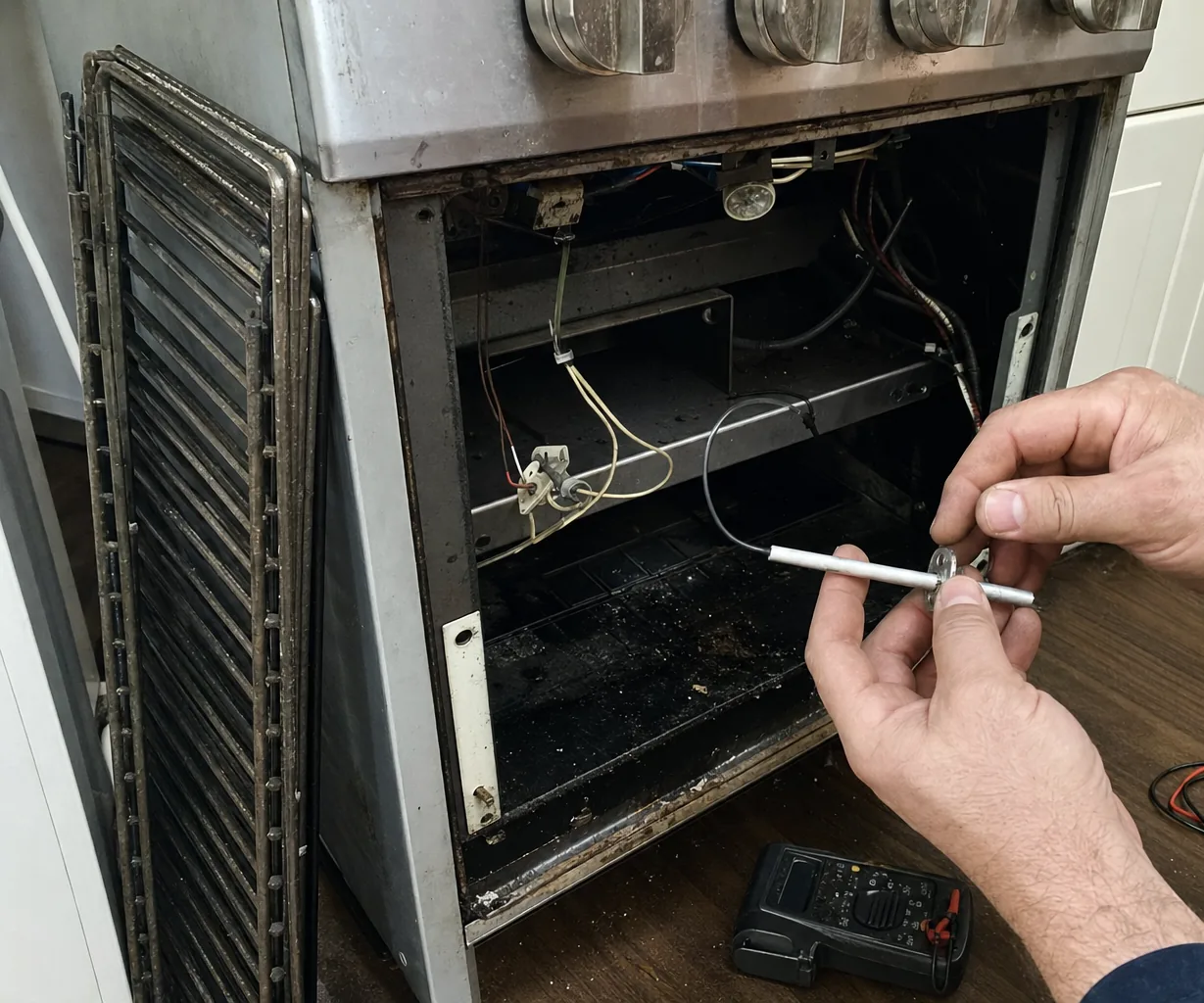
Most of Clay County was built around a standard slide-in range, and the professional appliance arrived later. That sequence produces a recognisable set of faults that look electrical and are actually installation.
Fleming Island grew mostly in the last three decades, and it grew around builder appliances: a standard thirty-inch slide-in range, a modest hood, a cabinet run laid out to a plan drawn before anyone specified a professional cooktop. The Wolf usually arrived later, during a remodel, into a space that was adapted rather than designed for it.
That sequence is not a problem in itself. Good remodels handle it. But when a fault appears in an appliance that has been retrofitted, the installation is worth twenty minutes of attention before any part is ordered — because a surprising share of “appliance faults” are installation faults wearing a convincing costume.
Four things we check on a retrofit
Clearance. A thirty-inch opening widened for a thirty-six-inch appliance sometimes loses its specified side and rear clearance in the process. Those figures are not conservatism. They set how much heat the cabinet and the valve bodies see. An appliance boxed too tightly runs hotter than it was designed to and produces intermittent faults that come and go with heavy cooking — exactly the kind that is impossible to reproduce on a Tuesday morning visit.
Gas sizing. A line sized for a builder range is occasionally asked to feed a great deal more burner. It behaves acceptably with one burner lit and poorly with four, which the owner experiences as “it just does not boil like it used to”. A manometer at the appliance under load answers this in ten minutes and no part answers it at all.
Circuits. A dual-fuel range needs its electric side properly supplied, and a built-in oven usually wants a dedicated circuit. Remodels sometimes share the nearest available one. Shared circuits produce voltage sag under load, and voltage sag is unkind to control boards over years.
Ventilation. Hood ducts in a retrofit take the route the framing allowed. A long horizontal leg with two tight elbows halves the airflow of a healthy blower, and the owner concludes the hood is failing when the hood is fine.
Why this matters more than it sounds
None of these findings mean the appliance is faulty, and none of them are a reason to refuse a repair. They matter because they change what the right repair is.
If a control board has failed in a house where the oven shares a circuit with something heavy, fitting a new board and leaving is selling the same part twice. If a rangetop misbehaves only during long cooking, and the cabinet is running twenty degrees warmer than the specification allows, an ignition part will not help. If a hood underperforms because of its duct, a blower is an expensive way to keep the current result.
What you can check yourself
Look at the paperwork from the remodel, if it exists. Note whether the installation was permitted and inspected — Clay County keeps those records and they are a legitimate thing to ask about, particularly if you bought the house after the work was done.
Then, with the appliance cool and off, look at whether anything obviously obstructs the ventilation openings around it. Toe-kick vents blocked by flooring laid up to the cabinet base, or a rear opening papered over during a backsplash job, are both things we have found.
When it is a genuine parts fault
Often it is. Sensors age, igniters crack, hinges lose their spring, blowers pick up bearing noise. The point of checking the installation first is not scepticism about the appliance — it is that a repair carried out on a bad installation does not last, and telling you so before the invoice is the whole job.
The flat diagnostic covers finding the actual cause, and it is credited toward the repair. The estimate is written and arrives before any order.
Before the estimate
What would this cost to put right?
Flat $80 diagnostic covering the visit and the full diagnostic sequence, credited toward the repair once you approve the work. Everything below it is what that class of repair has actually run here, parts and labour together — a range rather than a single number, because the firm figure is only honest once the fault has been measured.
| What was wrong | Usual total |
|---|---|
| $80 diagnostic visit | $80 |
| Oven thermostat or temperature sensor | $190–$550 |
Ranges, not quotes. Which band a job lands in depends on the part and on how much has to come apart to reach it, and that is settled by the diagnostic rather than by the telephone. The written estimate carries one figure and a lead time, and nothing is ordered until you have agreed to it.
Asked on the telephone
Is a thirty-year-old built-in worth keeping?
Often, because the cabinetry around it is the expensive part. A built-in has to be replaced by something that fits the existing opening, and openings of that era rarely match what is sold now. The rates page sets the repair bands beside what a comparable appliance costs, which is the comparison worth making.
Why does the opening matter so much?
Because a built-in is carried by the cabinet, not by the floor. Width, depth, the trim overlap and the cut-out for the supply all have to agree with the new unit, and where they do not the joinery becomes the job and the appliance becomes the easy part.
What tends to fail on one of these first?
The parts that move and the parts that get hot: door hinges and the seal, the element or igniter, the sensor, and eventually the control. Most of it is serviceable. Parts are matched to the serial number, and where something is obsolete you will hear that before an estimate is written.