What we fix
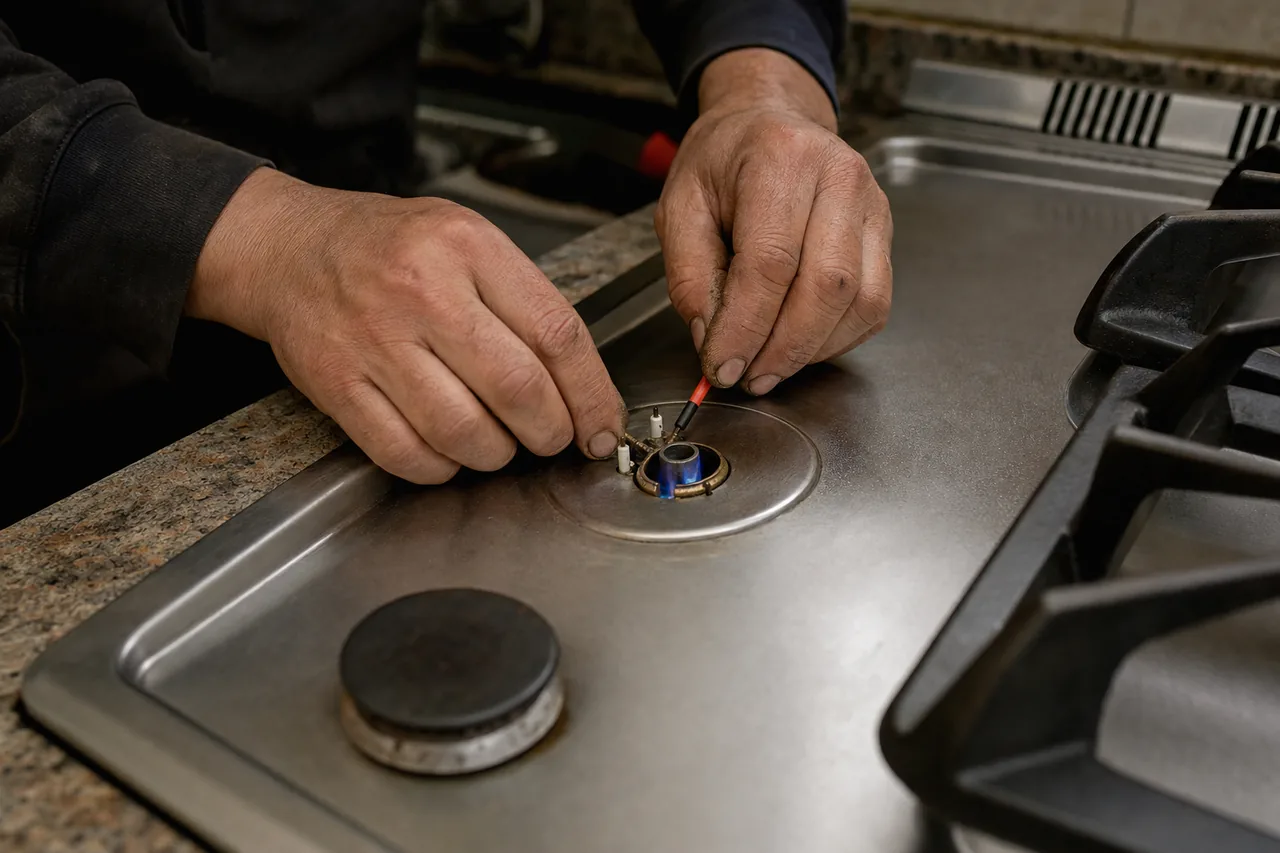
A Wolf cooktop or rangetop that clicks, burns yellow or drops a zone
Gas cooktops, induction cooktops and sealed-burner rangetops. Ignition that will not stop clicking, burners that burn yellow, and induction zones that drop out.
What it usually looks like
- The clicking continues after the burner is already lit
- A flame is yellow and lazy instead of blue
- One burner will not light while the rest are fine
- An induction zone stops heating part way through cooking
- The induction cooling fan runs long after everything is off
- A pan that used to work is no longer recognised
- A control knob spins loose or feels gritty
- There is a gas smell at the appliance
A cooktop or a rangetop is a simpler machine than a range, and that works in your favour. There is no oven cavity, no door, and no convection circuit, so the fault is almost always in one of three places: the gas path, the ignition path, or the power electronics under an induction surface.
If you smell gas, stop reading and shut the supply off at the appliance valve. That is a utility call before it is ours.
Gas burners and the shape of the flame
A healthy sealed burner burns blue with a sharp inner cone and no flutter. Every common gas fault changes that picture in a way you can read from across the kitchen.
Yellow, soft and slow is a mixture problem. The usual causes are a partly blocked orifice, debris in the burner ports, or an appliance running on a gas it was not set up for. Fleming Island has both natural-gas streets and propane tanks, and a conversion carried out without changing every orifice and re-checking the regulator gives exactly this flame.
Flames that lift off the ports and roar suggest too much pressure or too much air. Flames that only occupy part of the ring almost always mean a cap sitting off-centre or a port ring that has not been cleared since a pot boiled over.
Clicking that never stops after the burner lights is not an ignition failure at all. It is the flame-sensing side of the circuit failing to confirm what is plainly burning, usually because the electrode tip is carboned or the ceramic around it has cracked and is leaking spark to the burner body.
Induction, which fails differently
An induction cooktop has no flame to read, so the diagnosis moves to the coil, the inverter board and the cooling that keeps them alive.
The first thing to rule out is the pan. Induction requires a ferrous base, and some tri-ply pans lose their magnetic layer to warping after years of heat cycling. A refrigerator magnet on the base of the pan settles that question in two seconds and costs nothing.
A zone that heats and then quits part way through a long simmer is usually thermal. The electronics under the glass are cooled by a fan drawing through a filtered intake, and in a slab-on-grade kitchen with the cooktop over a cabinet run that intake collects dust faster than anyone expects. The board protects itself by shutting the zone down. Cleaning the path is often the whole repair.
A zone that never works, on a cooktop where the others are fine, points at the coil or its drive stage. That is a board-level part and it is not a cheap one, so we confirm it with measurements and tell you the number before anything is ordered.
Rangetops in a remodelled cabinet
A rangetop drops into a countertop cut-out with an oven or two beneath it, and the most common non-electrical fault we find is heat, not the appliance. Where a rangetop was fitted into an older cabinet run without the specified clearances, the trapped air raises the temperature around the valve bodies and control electronics until something intermittently misbehaves. It presents as a fault that comes and goes with heavy cooking, and it is worth measuring rather than chasing parts.
What the visit includes
The flat diagnostic covers the trip and the time to test properly: manometer on the gas side where it is warranted, meter on the electrical side, and a written account of what was found. It is credited toward the repair. The estimate arrives before the parts order, the labour carries 90 days, and genuine OEM parts carry 365.
We work on Wolf cooking appliances and nothing else, and we are independent of the manufacturer.
Before the estimate
What does cooktop and rangetop work usually come to?
Flat $80 diagnostic covering the visit and the full diagnostic sequence, credited toward the repair once you approve the work. Everything below it is what that class of repair has actually run here, parts and labour together — a range rather than a single number, because the firm figure is only honest once the fault has been measured.
| What was wrong | Usual total |
|---|---|
| $80 diagnostic visit | $80 |
| Igniter or spark module replacement | $210–$540 |
| Burner valve or orifice service | $210–$650 |
| Oven thermostat or temperature sensor | $190–$550 |
| Control board or touch panel | $430–$1,070 |
Ranges, not quotes. Which band a job lands in depends on the part and on how much has to come apart to reach it, and that is settled by the diagnostic rather than by the telephone. The written estimate carries one figure and a lead time, and nothing is ordered until you have agreed to it.
Asked on the telephone
Why does an induction zone stop part way through cooking?
The cooking surface rarely fails. What sits under it is electronics cooled by a fan pulling air through a grille, and a blocked intake, a dusty filter or a slowing fan makes the zone throttle itself to protect the inverter board. The zone is usually healthy; the cooling around it is not.
Are a cooktop and a rangetop the same repair?
The burners behave alike: electrode, cap seat, port and valve. What differs is everything around them. A rangetop sits in a cabinet cut-out with clearances of its own, and a grill or griddle module adds an element and a thermostat that a cooktop does not carry. Access differs more than the fault does.
What makes a flame lazy and yellow?
Air, gas pressure or a blocked port, in that order. On propane a tired regulator softens every burner at once, and that simultaneity is the giveaway. One lazy burner on its own is nearly always the cap sitting proud of its seat, a partly plugged port, or an air shutter disturbed during a clean.
The terms, unchanged
$80 flat diagnostic, credited toward the repair. You get a written estimate before any part is ordered or any labour is billed. Genuine OEM parts, with 90 days on labour, 365 days on parts.
Burner caps, electrodes and spark modules are usually stocked within a week. Induction boards can take longer and we will tell you before you commit.