Quiet note
Wolf stove replacement parts, or is it time for a new range?
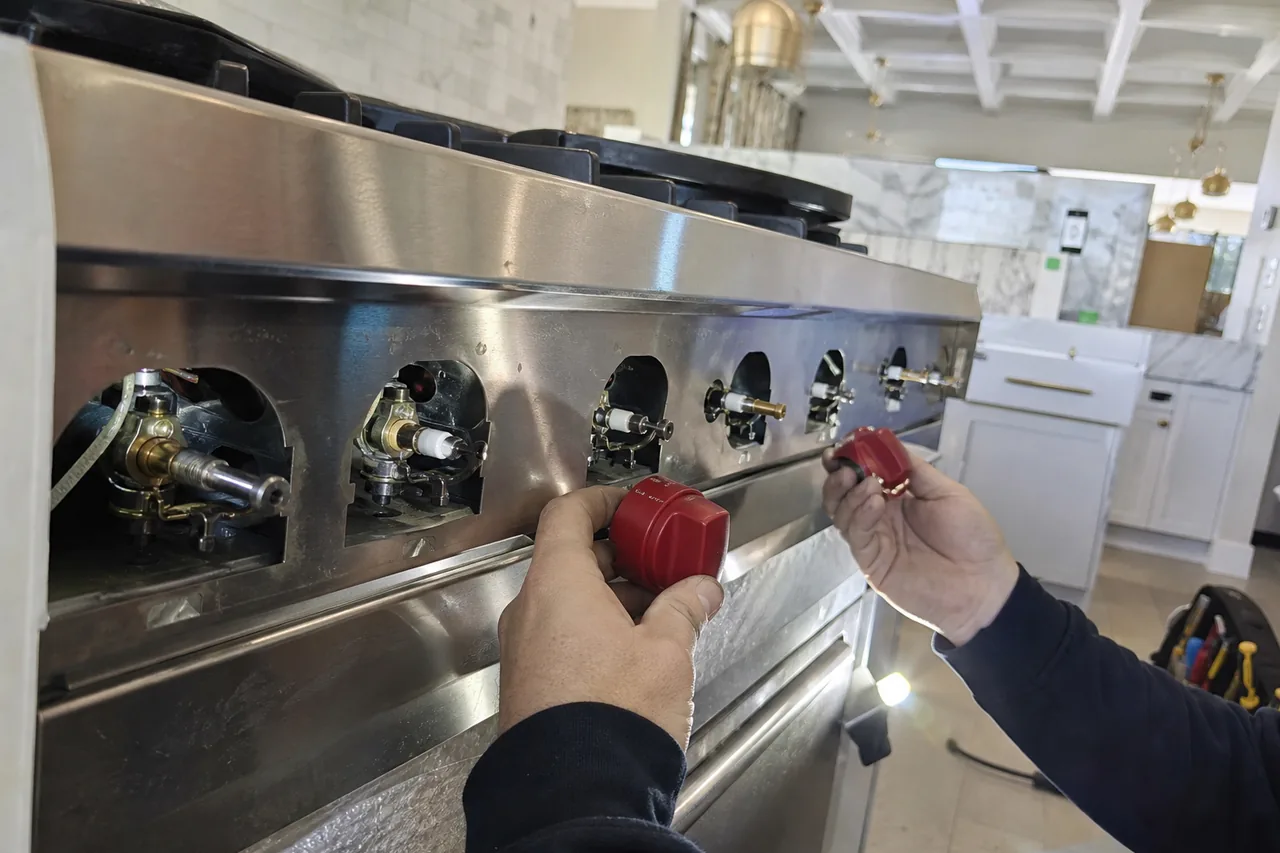
How to choose between ordering Wolf range parts and replacing the whole range: its age, which part failed, how often it has failed, and what pulling a built-in involves.
Wolf stove replacement parts are worth buying far more often than a new range is. What wears out on a Wolf range is the igniters and spark module, gas valves, oven temperature sensor, door hinges and gasket, and control board, and each is replaced by itself while the steel body and oven cavity stay put. An igniter job typically runs $210–$540 and a control board $430–$1,070, while a replacement unit typically lands at $5,200–$16,500 before anyone touches the cabinets. The firm figure comes after an $80 diagnostic. A new range only starts to make sense when the same fault keeps coming back or several big parts are going at once.
Read the tags before ordering anything
Parts are matched to the model and serial number, so find those first. A Wolf model number opens with a product code (DF for dual fuel, GR for all gas, IR for induction, SRT for a sealed burner rangetop), and an -LP ending marks a propane unit.
On DF, IR and GR ranges, open the oven door and look along the bottom of the control panel at the far right; an SRT rangetop uses that same corner. Older R Series ranges and RT Series rangetops hide the tag under the left surface burner pan, on the left wall of the burner box. To tell the generations apart, a GR has sealed burners, one grate bridging two burners and a stainless light button, while an R Series has open burners, a grate per burner and a black toggle.
The tag and rating plate also read NG or NAT for natural gas, or LP for propane, and a converted range carries a second sticker naming the new gas. Valves and orifices differ by fuel, so this decides the order.
Check the recall first
If you own a dual fuel range with an infrared griddle, such as DF36450G/S/P, compare its serial number with recall 25-034. It covers serials 18517201 to 18868311 and 10006001 to 10006009, because a spill can short the range and switch the griddle on without warning. Stop using an affected range and call Wolf, which repairs it in your home free of charge.
Four questions that settle repair or replace
- How old is it? A young range with one failed part is a repair. An older one is often still worth fixing, since the steel rarely wears out; electronics and moving parts age.
- Which part failed? An igniter, spark module, valve, sensor or door seal is a contained job. The control board is the costly one, so find out whether it died alone or after a surge or spill, as described in our note on storm damage.
- How many times? The same part failing twice points to a cause elsewhere, such as moisture or a chafed harness. Several unrelated major repairs close together is when replacement deserves a real look.
- What would replacement involve? More than most owners expect.
What swapping a built-in range really takes
A Wolf range is rarely a simple swap. The opening, countertop and hood were sized around the old unit, so a different width or depth means carpentry, and a dual fuel model needs both gas and a matching circuit. On propane, the new range has to be converted, and Wolf wants a service technician to do it: DF3050-DF6050 models take kit 829533 to go from natural gas to LP and 829536 to go back, and only the griddle gives up 2,000 Btu on LP. The anti-tip device has to go back in as well, since Wolf says one should always be fitted; the kit for current dual fuel and induction ranges is 829936.
Warranty and where parts come from
During the first two years after installation, Wolf’s full warranty pays for defective parts and labor, so contact Wolf before paying anyone. Under the limited five-year coverage that follows, an owner using service outside Wolf’s network must get repaired or replacement parts through Wolf, which will not refund parts bought elsewhere. Outside those terms, we fit genuine OEM parts.
Getting a firm number
For homes on Fleming Island, Pace Island and around Doctors Lake, a range repair visit starts with the $80 diagnostic. The technician confirms the failed part, looks for whatever caused it and prices the job before ordering. Typical ranges are $210–$650 for a burner valve or orifice, $190–$550 for an oven thermostat or temperature sensor and $180–$660 for a door hinge, glass or seal. If a burner only clicks, read when a burner clicks and will not light first.
Before the estimate
What would this cost to put right?
Flat $80 diagnostic covering the visit and the full diagnostic sequence, credited toward the repair once you approve the work. Everything below it is what that class of repair has actually run here, parts and labour together — a range rather than a single number, because the firm figure is only honest once the fault has been measured.
| What was wrong | Usual total |
|---|---|
| $80 diagnostic visit | $80 |
| Burner valve or orifice service | $210–$650 |
| Igniter or spark module replacement | $210–$540 |
Ranges, not quotes. Which band a job lands in depends on the part and on how much has to come apart to reach it, and that is settled by the diagnostic rather than by the telephone. The written estimate carries one figure and a lead time, and nothing is ordered until you have agreed to it.