Field notes
Quiet notes
Notes written between calls. No hype, no listicles — the things worth knowing before you pick up the phone.
-
Wolf stove replacement parts or a new range
How to choose between ordering Wolf range parts and replacing the whole range: its age, which part failed, how often it has failed, and what pulling a built-in involves.
ranges · replacement-parts · repair-or-replace · gas-burners
-
Reading Wolf oven error codes before you call
What the codes and messages on a Wolf oven or range mean, which ones an owner can clear with a simple check or a breaker reset, and which ones always mean a service visit.
ovens · error-codes · diagnostics · controls
-
When a Wolf oven will not heat
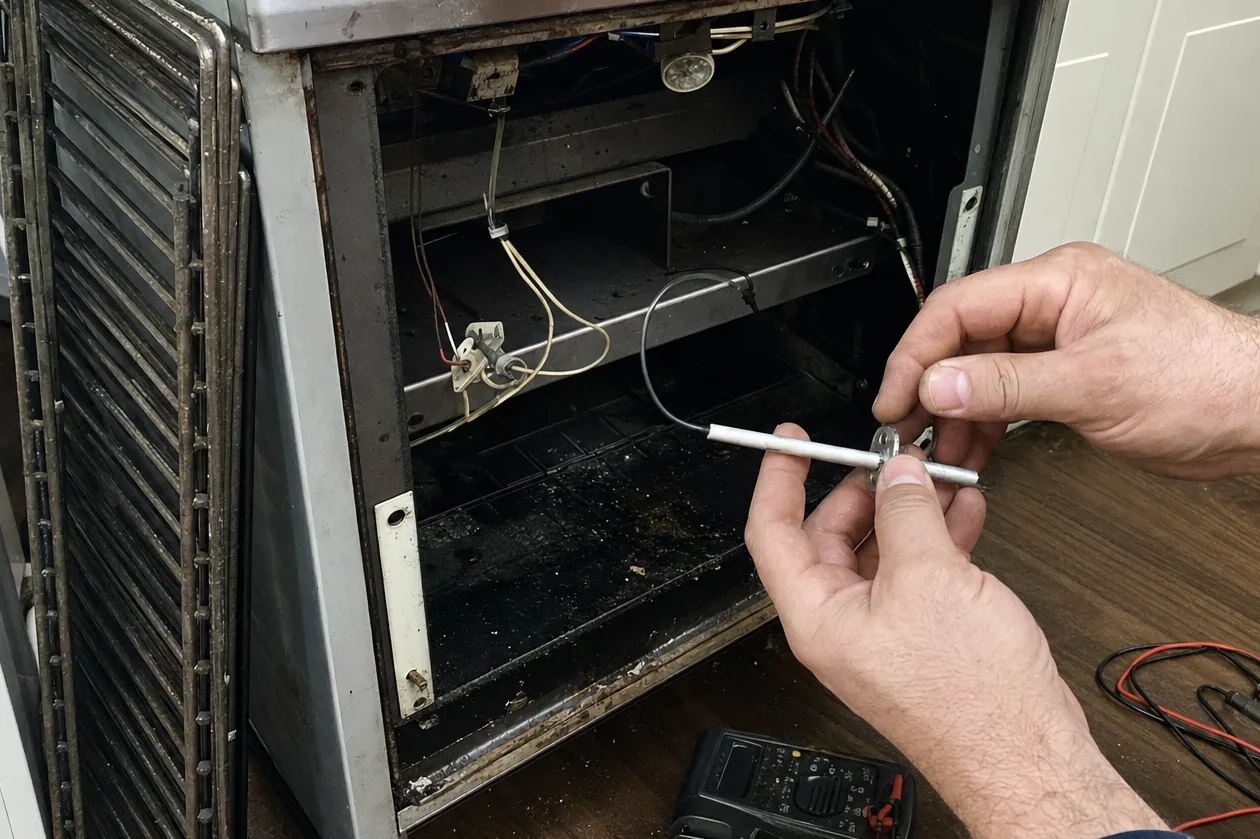
An oven that will not heat at all is a different fault from one that drifts off temperature. Bake element, igniter, relay, temperature sensor, or a control that latched after a self-clean — what still works narrows it before anybody drives out.
ovens · heating · ignition · diagnostics
-
A nineties kitchen and a Wolf built-in oven
Most of Clay County was built around a standard slide-in range, and the professional appliance arrived later. That sequence produces a recognisable set of faults that look electrical and are actually installation.
installation · retrofit · clay-county
-
Storm season and Wolf control boards
North Florida averages around 68 thunderstorm days a year. Almost none of the damage we see is a direct strike — it is the surge that arrives a moment behind one, and it lands on the lowest-voltage part of the appliance.
control-boards · storms · clay-county
-
Why a Wolf hood needs makeup air
Most hoods that stopped working still work. What changed is everything downstream of the blower — filters, duct, damper — and, in a tightly built house, whether any air is available to replace what the hood removes.
ventilation · makeup-air · blowers
-
The Wolf oven that drifts off temperature
An oven that browns unevenly or runs twenty degrees off is usually reporting a tired temperature sensor or leaking heat past a tired gasket. Those two faults look identical from the kitchen and are told apart in an afternoon.
ovens · temperature · diagnostics
-
When a Wolf burner clicks and will not light
Continuous clicking with no flame is the most common gas call of the year. The pattern of which burners click, and which do not, narrows the fault to one of four things before any tool comes out.
gas-burners · ignition · diagnostics
Before the estimate
What do the repairs in these notes cost?
Flat $80 diagnostic covering the visit and the full diagnostic sequence, credited toward the repair once you approve the work. Everything below it is what that class of repair has actually run here, parts and labour together — a range rather than a single number, because the firm figure is only honest once the fault has been measured.
| What was wrong | Usual total |
|---|---|
| $80 diagnostic visit | $80 |
| Igniter or spark module replacement | $210–$540 |
| Burner valve or orifice service | $210–$650 |
| Oven thermostat or temperature sensor | $190–$550 |
| Convection fan or motor | $260–$700 |
Ranges, not quotes. Which band a job lands in depends on the part and on how much has to come apart to reach it, and that is settled by the diagnostic rather than by the telephone. The written estimate carries one figure and a lead time, and nothing is ordered until you have agreed to it.
Asked on the telephone
What are these notes for?
They are the answers that would otherwise be given on the telephone twice a week, written down once. Each takes a single symptom and shows how it gets narrowed, so an owner can tell whether the thing in their kitchen is a small fault or a large one before anybody drives out.
Are they instructions?
No. They stop short of anything involving gas, mains voltage or a panel that has to come off. What they do is explain what a technician is looking at and in what order, which is usually enough for a reader to describe the fault accurately when they call.
Is there anything I can check myself first?
The safe checks are worth doing: whether the outlet still has power, whether the burner caps sit flat and dry, whether anything else on the same circuit went out with it. Everything past that belongs to somebody with a meter, and describing what you found is more useful than opening anything.