Quiet note
The Wolf oven that drifts off temperature
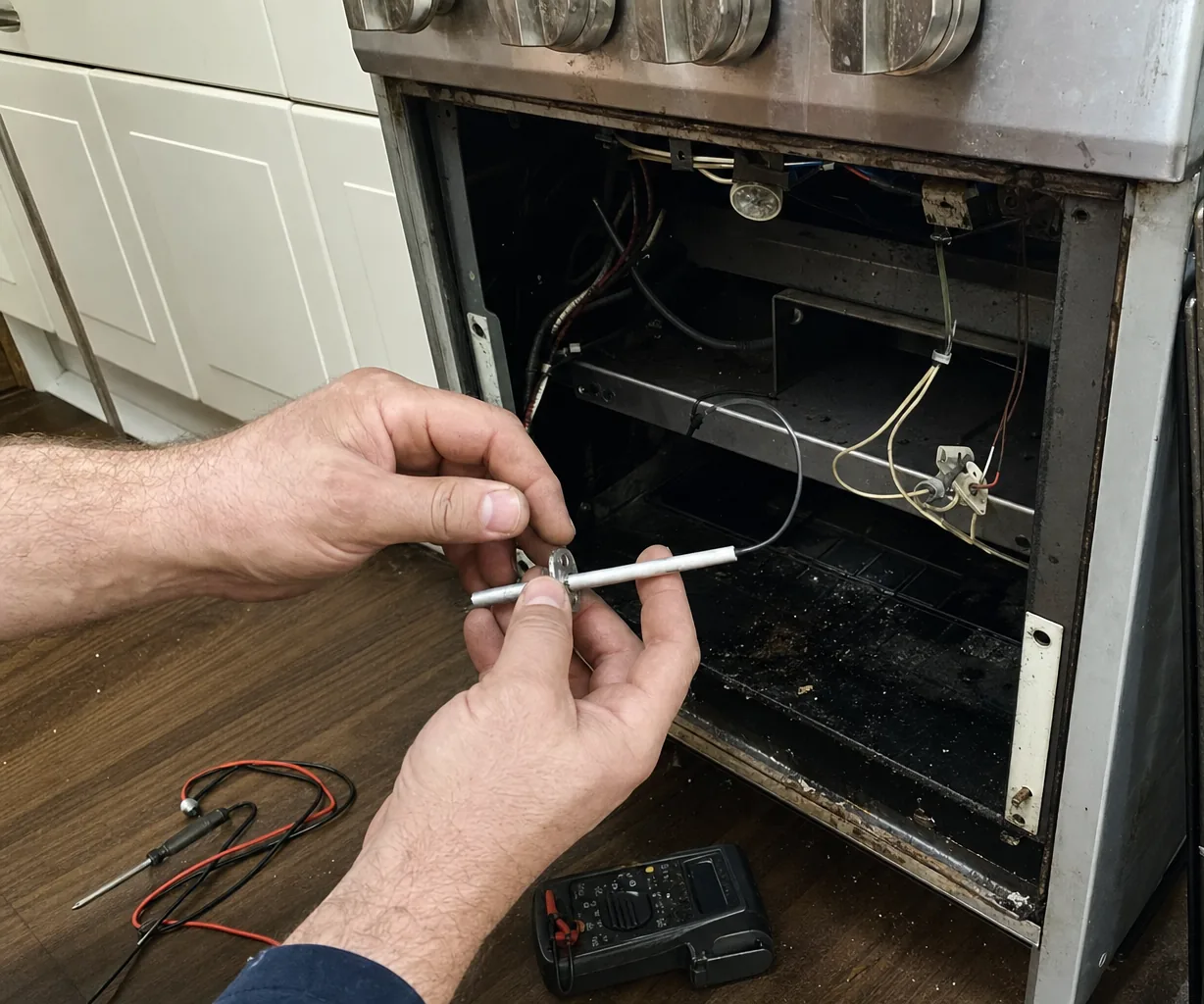
An oven that browns unevenly or runs twenty degrees off is usually reporting a tired temperature sensor or leaking heat past a tired gasket. Those two faults look identical from the kitchen and are told apart in an afternoon.
Nobody notices an oven drifting. They notice that a recipe they have made for eleven years suddenly needs six more minutes, and they blame the recipe. By the time it gets described to us it has usually been going on for a season.
There are four common causes, and you can separate three of them at home.
First, measure something
Buy an oven thermometer — the dial type that hangs from a rack is adequate — and put it in the centre of the middle rack. Set the oven to 350°F, let it preheat, and then leave it another twenty minutes. This part matters. An oven reports preheat complete when the sensor is satisfied, not when the walls and racks have caught up, and the mass of a built-in cavity takes a while.
Read the thermometer at twenty minutes and again at forty. Write both down.
Steady and wrong — the same 25°F low at both readings — is an offset. Most ovens have a user calibration adjustment for exactly this, and the owner’s manual will tell you how far it can be moved. That is a five-minute job and no visit.
Wandering — right at twenty minutes, twenty degrees off at forty, then back — is a sensor or a control fault. The cavity is cycling around a target it cannot hold.
Never arriving — climbing slowly and stalling short — is a heating fault: an element, the relay that drives it, or on a gas oven the burner and its ignition.
The sensor, and why we measure it twice
An oven temperature sensor is a resistance probe. Its resistance rises with temperature along a curve the manufacturer publishes, which means it can be checked against a real number rather than a hunch.
We measure it cold, compare it with the maker’s own table, and then measure it again at temperature. This catches the failure mode that a single cold reading misses entirely: a sensor that reads perfectly at room temperature and wanders once it is hot is still a bad sensor, and it is the one that produces the “sometimes it is fine” complaint.
The sensor is not usually an expensive part. Diagnosing it by replacement, however, is an expensive habit.
The door is the other half of the story
Half the drifting ovens we see are not drifting at all. They are leaking.
Put a sheet of paper across the door seal and close the door on it. Pull. If it slides out with no resistance, the gasket is not sealing at that point. Repeat at several points across the top and both sides. A gasket that has flattened with age, or a door that has dropped on a hinge that lost spring tension, lets enough heat past the seal to pull the front of the cavity cold while the sensor at the back keeps reporting that everything is fine.
This is why calibration does not fix it. You can offset the control all you like; you are correcting a number, not a leak. The repair is a gasket or a hinge, and both are mechanical parts with predictable lifetimes.
Uneven browning is usually air, not heat
If one side of the tray browns and the other stays pale, look at circulation before temperature. In a convection cavity the fan flattens the gradient between top and bottom. A fan slowed by a dry bearing, a blade that has loosened on its shaft, or a rear baffle refitted a few millimetres out of position after a clean will bake on a slope no matter how accurate the sensor is.
Rotate a tray halfway through and see whether the result evens out. If it does, the fault is circulation.
A word about self-clean
Self-clean runs the cavity far above any cooking temperature for hours, and it is the condition that finds a marginal latch motor, a tired thermal cut-out or a door switch that was already intermittent. It is not a cycle to run for the first time in two years on the night before a holiday.
What we do
The flat diagnostic covers the trip and a full set of measurements — sensor cold and hot, element and relay, the door and the seal — and it is credited toward the repair. The written estimate comes before any part is ordered. Labour carries 90 days, genuine OEM parts 365.
Before the estimate
What would this cost to put right?
Flat $80 diagnostic covering the visit and the full diagnostic sequence, credited toward the repair once you approve the work. Everything below it is what that class of repair has actually run here, parts and labour together — a range rather than a single number, because the firm figure is only honest once the fault has been measured.
| What was wrong | Usual total |
|---|---|
| $80 diagnostic visit | $80 |
| Oven thermostat or temperature sensor | $190–$550 |
Ranges, not quotes. Which band a job lands in depends on the part and on how much has to come apart to reach it, and that is settled by the diagnostic rather than by the telephone. The written estimate carries one figure and a lead time, and nothing is ordered until you have agreed to it.
Asked on the telephone
How do I know the oven is really off temperature?
A separate thermometer left in the cavity through a full cycle tells you more than the display can, because an oven swings around its setting by design. What matters is where the swing sits, not any single reading, and a logged probe is what settles the argument between the two.
Is a slow climb a different fault to a wrong reading?
Yes, and it is the useful distinction. Never arriving, meaning climbing slowly and stalling short, points at heating. Arriving and then sitting in the wrong place points at sensing. One sends a technician to the element or the burner, the other to the sensor and its lead.
Can the door cause it?
Easily. A door that has dropped, or a seal that has gone hard, lets heat out along one edge and the control simply keeps calling for more. Hinges and the seal are checked on any drift call, because fitting a sensor to an oven that leaks heat only moves the problem along.