Where we go
Wolf igniters, oven sensors and storm-hit boards on Fleming Island
Clay County, ZIP 32003 and 32006. A peninsula of oak canopy and lake frontage where igniters, oven sensors and control boards make up most of the working week.
- County
- Clay County
- ZIP
- 32003, 32006
- Getting there
- Fleming Island is the first stop on the week, not an outlying one. Most of the route is within a few minutes of County Road 220.
- Communities
- Eagle Harbor · Pace Island · Hibernia Plantation · Doctors Lake
Fleming Island sits in Clay County, not Duval and not St. Johns, and that distinction is not pedantry. It changes the housing stock, the service route and the kind of call that comes in, and all three show up in the work.
This is a peninsula with the St. Johns River on one side and Doctors Lake on the other, reached by US 17 down the spine and County Road 220 across the middle. The kitchens here are largely of the last three decades: Eagle Harbor’s master-planned streets, the gated lots along the water at Pace Island, the oak-canopy river frontage at Hibernia Plantation.
Repair or replace, on a built-in
A freestanding range can be wheeled out and swapped in a morning. A built-in wall oven, a rangetop or a downdraft cooktop cannot, and that changes the arithmetic of every quote we write.
A built-in is fitted to an opening. Replacing it means finding an appliance that matches the cut-out width, the height of the existing rough opening, the depth the cabinet run allows and the position of the gas stub or the junction box. When the match is not exact the cost stops being the appliance and starts being the cabinetry, the countertop cut and sometimes an electrician. That is why a built-in is usually worth repairing well past the point at which a freestanding appliance would not be.
The honest limits still apply. When a repair approaches the cost of the appliance, when the part has gone obsolete, or when the fault is one of several on an appliance that has begun to fail generally, we say so on the estimate and leave the decision with you. We would rather lose the job than sell a repair we would not pay for ourselves.
What a first visit does before it touches a part
The order is deliberate. Supply first — voltage at the junction box or gas pressure at the appliance under load — because a control board fitted onto a supply fault is a board that fails twice. Then the part that has been accused, read on a meter rather than swapped on a hunch. Then the path to it: harness, connector, ground and door switch, since a good share of what gets called a dead board is a broken path to a working one.
What the summer actually costs you
North Florida sees roughly 68 thunderstorm days a year. The damage we see is almost never a direct strike. It is the surge that arrives a moment behind one, riding in on the distribution circuit and finding the lowest-voltage electronics in the house.
Inside a range or a built-in oven that is the control board — the logic that reads the sensor and drives the relays, not the heavy elements themselves. A range that was fine at dinner and dark on Wednesday morning is the single most common call we take here between June and September, and the fix begins with testing the supply rather than replacing the board and hoping.
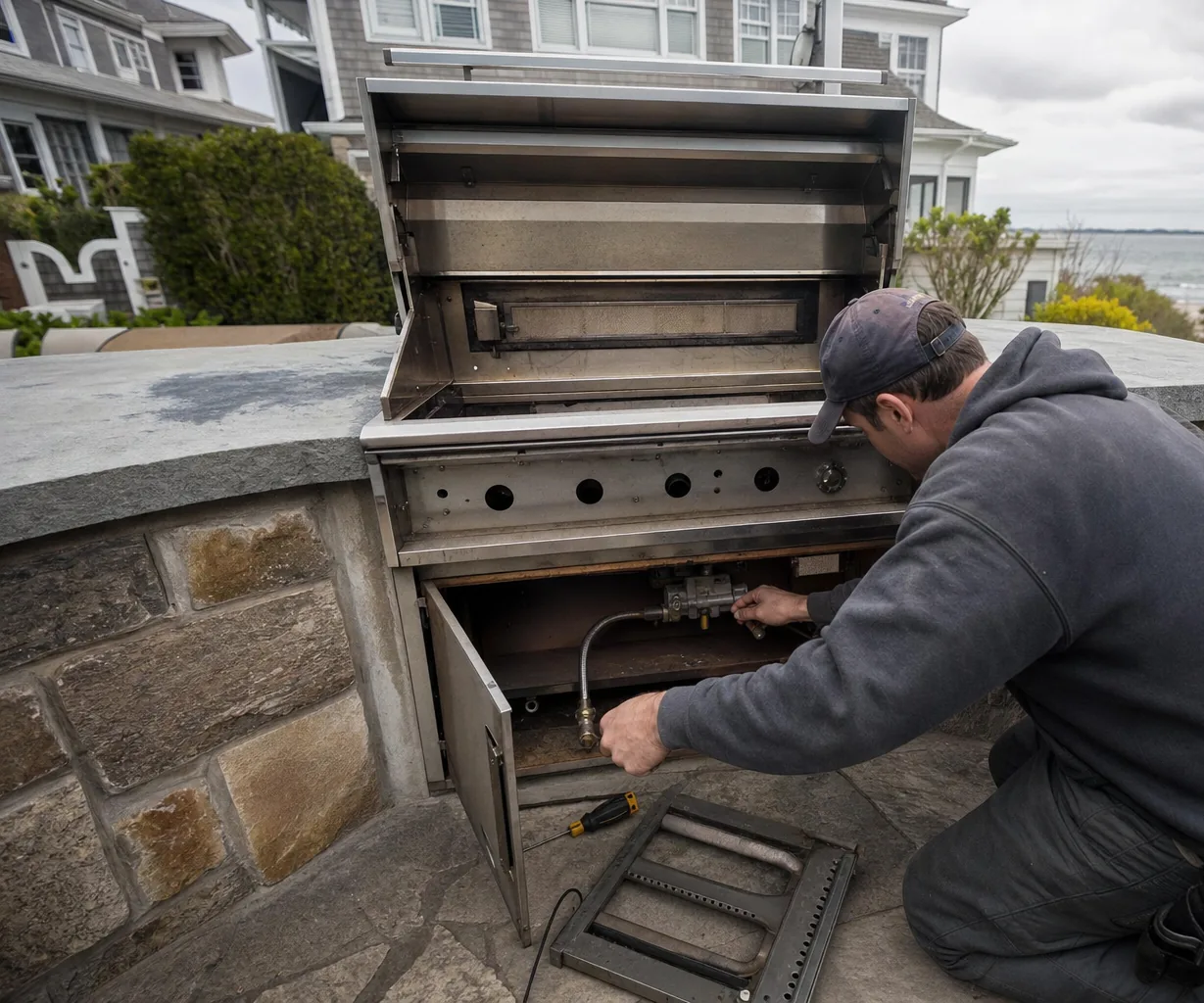
The other summer variable is humidity. Ninety per cent air gets into outdoor kitchens, cracks ceramic insulators on grill electrodes, and stiffens valve stems that were fine in March.
This is not the beach
Fleming Island is inland water, not the ocean. The condenser-fin corrosion and hinge pitting that dominate service work in the beach ZIP codes east of the Intracoastal are not what we find here, and pretending otherwise would be a way of selling something. Our corrosion story is humidity and rain, and it is concentrated outdoors.
Getting to you
Fleming Island is the first stop on our week rather than an outlying one, so a visit here rarely needs to be scheduled around a long drive. Gated communities add a step — we ask for a gate code or a call-ahead arrangement when the booking is made, not when the van is at the gate.
Visits run Monday to Friday between 8:00 am and 6:00 pm and on Saturday between 9:00 am and 4:00 pm. We do not run an after-hours call-out service, and we would rather say that plainly than let you find out at nine on a Sunday evening.
What the visit costs
A flat diagnostic covers the trip and the time to find the fault properly. It is credited in full toward the repair if you go ahead with the work. The estimate is written and it arrives before any part is ordered. Labour carries 90 days, genuine OEM parts carry 365.
We work on Wolf cooking appliances and nothing else, and we are independent of the manufacturer.
$80 flat diagnostic here, the same as everywhere else on the route. You get a written estimate before any part is ordered or any labour is billed.
Before the estimate
What does a repair cost in Fleming Island?
Flat $80 diagnostic covering the visit and the full diagnostic sequence, credited toward the repair once you approve the work. Everything below it is what that class of repair has actually run here, parts and labour together — a range rather than a single number, because the firm figure is only honest once the fault has been measured.
| What was wrong | Usual total |
|---|---|
| $80 diagnostic visit | $80 |
| Igniter or spark module replacement | $210–$540 |
| Burner valve or orifice service | $210–$650 |
| Oven thermostat or temperature sensor | $190–$550 |
| Convection fan or motor | $260–$700 |
Ranges, not quotes. Which band a job lands in depends on the part and on how much has to come apart to reach it, and that is settled by the diagnostic rather than by the telephone. The written estimate carries one figure and a lead time, and nothing is ordered until you have agreed to it.
Asked on the telephone
Are you actually based on Fleming Island?
Yes. The bench is here and the van starts here, so the two ZIPs that make up Fleming Island proper are the first addresses of the week rather than the far end of somebody elses patch. Everything else on the route is measured outward from this one place.
What fails most often in kitchens here?
Ignition and electronics. Spark modules that click without catching, oven sensors that drift a little further each month, and boards that stop answering the morning after a storm. Storm season is the busy part of the year, and the surge that follows a nearby strike ends more boards than the strike itself.
What should I do before the visit?
Leave the appliance as it is. A fault that has been reset, cleaned and reassembled has to be reproduced before it can be measured. Note what it did and roughly when, clear the cabinet in front of it if you can, and put the dogs somewhere else for an hour.