Quiet note
Why a Wolf hood works better with a window open
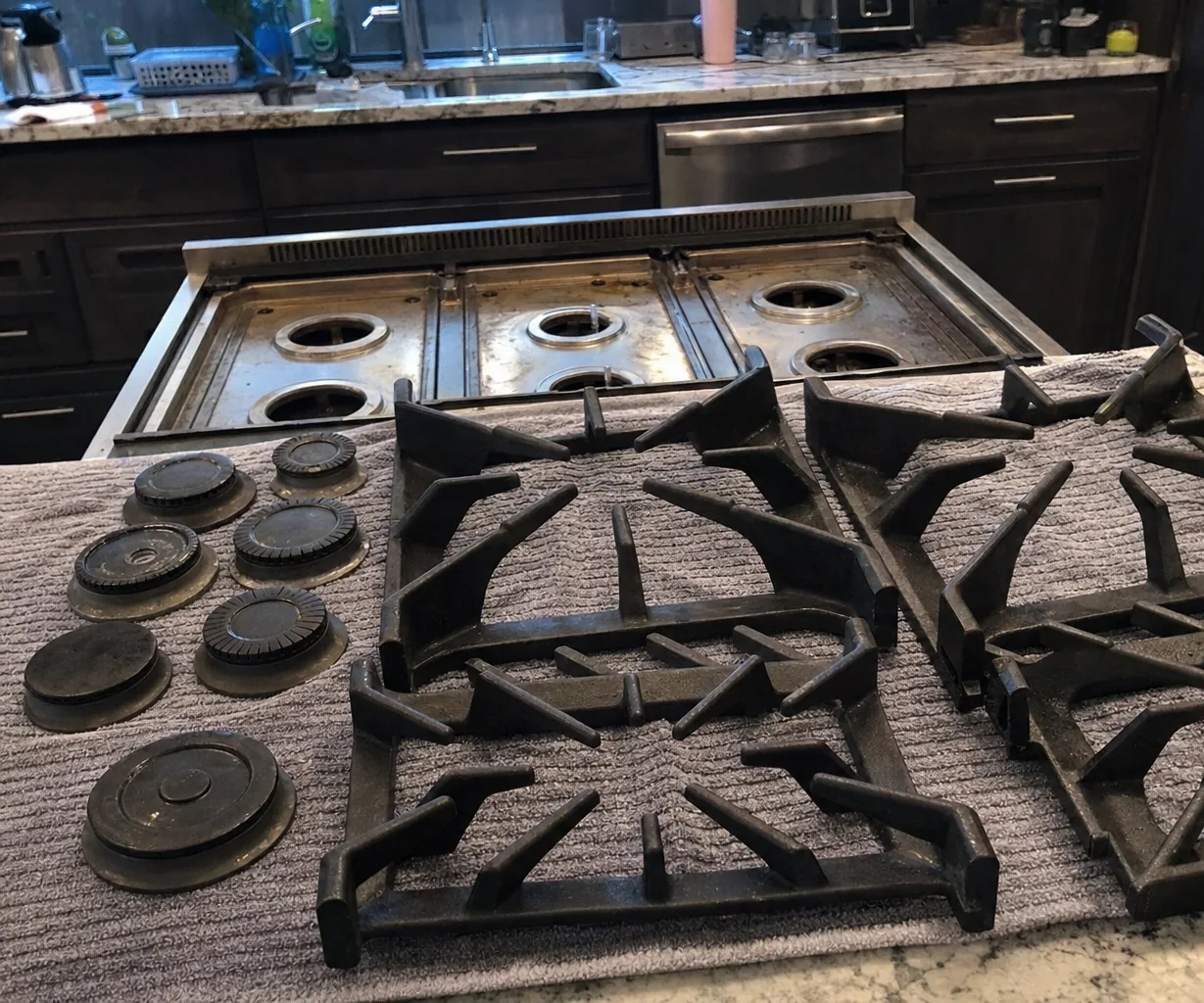
Most hoods that stopped working still work. What changed is everything downstream of the blower — filters, duct, damper — and, in a tightly built house, whether any air is available to replace what the hood removes.
A homeowner tells us the hood has lost its power. They add, almost as an aside, that it still works fine if the kitchen window is open. That aside is the entire diagnosis, and it is not a broken appliance.
A hood cannot remove air the house cannot replace
Extraction is not a one-way operation. Every cubic foot a blower pushes outside has to be replaced by a cubic foot coming in from somewhere. In a leaky old house that air arrives through a hundred gaps and nobody notices. In a tightly built modern house — which is most of what stands on Fleming Island — there are fewer gaps, and the house resists.
When the house resists, the blower runs at full speed and moves a fraction of its rated air. Open a window and the resistance disappears, and the same blower suddenly performs. Nothing failed. The system was never given an inlet.
In most Florida jurisdictions the residential mechanical code requires a makeup-air provision once kitchen exhaust exceeds 400 cubic feet per minute. The reason is more than paperwork: pull that much air out of a sealed house and it will come back down the path of least resistance, and in a house with fuel-burning appliances that path can be a flue. Your county building department is the authority on what applies at your address, and it is a conversation worth having during a remodel rather than after one.
Before blaming the blower, look downstream
Most “weak hood” calls are resistance, not motor. In rough order of frequency:
Filters. Baffle filters loaded with grease cost airflow immediately and continuously. They are dishwasher-safe on most hoods and they are the cheapest performance improvement available to anyone.
The duct run. Length, elbows, and especially an elbow placed immediately at the blower outlet all cost air. A duct that had to follow the framing rather than the shortest route is a fixed constraint on the appliance, and no replacement blower changes it.
The damper. A backdraught damper stiff with hardened grease may only be opening halfway. On a windy day the same damper failing to close is why the kitchen smells of outside.
The termination. Roof and wall caps have screens. Screens collect lint, pollen and, in this climate, wasp nests.
What noise tells you
A blower that has always been loud is a duct and design question. A blower that became loud is mechanical, and the character of the sound narrows it fast.
A rumble that rises and falls with speed is imbalance — debris or grease loaded unevenly on one side of the wheel, or a wheel that has shifted on its shaft. A constant whine at one pitch is a bearing. A rattle that is worst on the lowest speed is often not the blower at all: it is a panel, a filter or a damper vibrating in an airstream no longer strong enough to hold it still.
Downdrafts and remote blowers
A downdraft works against the direction heat naturally travels, so every loss in the system hurts it more than it hurts an overhead hood. It also adds a lift mechanism — a motor, a drive and a limit switch — that can jam with grease.
Remote and in-line blowers put the noise in the attic or on the roof, which is a good trade for daily life and a scheduling consideration for a repair. We establish where the blower physically lives before quoting, because the answer decides whether the visit needs a ladder.
The honest version
If the diagnostic shows a healthy blower on a duct that will never deliver its rated airflow, we will tell you that and not sell you a motor. Sometimes the useful outcome of a service visit is a clear explanation and a clean set of filters.
Before the estimate
What would this cost to put right?
Flat $80 diagnostic covering the visit and the full diagnostic sequence, credited toward the repair once you approve the work. Everything below it is what that class of repair has actually run here, parts and labour together — a range rather than a single number, because the firm figure is only honest once the fault has been measured.
| What was wrong | Usual total |
|---|---|
| $80 diagnostic visit | $80 |
| Igniter or spark module replacement | $210–$540 |
| Burner valve or orifice service | $210–$650 |
| Oven thermostat or temperature sensor | $190–$550 |
| Convection fan or motor | $260–$700 |
Ranges, not quotes. Which band a job lands in depends on the part and on how much has to come apart to reach it, and that is settled by the diagnostic rather than by the telephone. The written estimate carries one figure and a lead time, and nothing is ordered until you have agreed to it.
Asked on the telephone
Why is the hood loud but not clearing the kitchen?
Noise is the blower working. Capture is the duct letting it. When those two disagree the restriction is downstream: a long run, too many elbows, a damper that will not open, a filter clogged enough to whistle. The blower is tested for what it can actually move before it is blamed.
Does a bigger blower fix a bad duct?
Rarely, and it usually makes the noise worse without improving capture. The air still has to get through whatever is already in the wall, and it still has to be replaced from somewhere inside the room. Sizing is the last thing to change, not the first.
What gets into the duct out here?
The cap at the far end is the part nobody ever inspects. Leaves, pollen, wasp nests and a damper stuck half open all collect there, and every one of them reads as a weak hood from inside the kitchen. It is the cheapest thing on the list to rule out.