What we fix
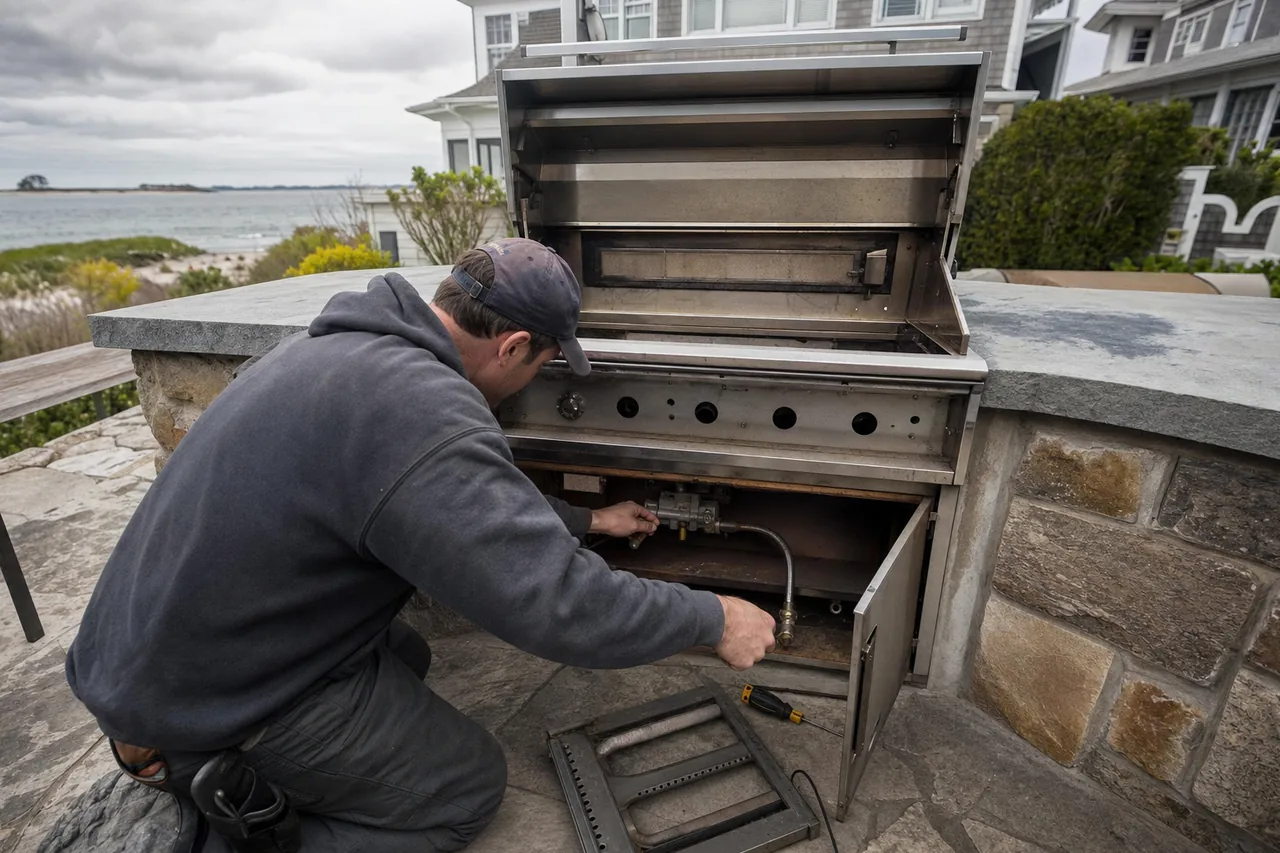
A Wolf outdoor gas grill that clicks, lights unevenly or seizes up
Built-in and cart outdoor gas grills. Ignition that will not catch, burners that light unevenly, hardware seized by a Clay County summer, and regulator faults.
What it usually looks like
- The igniter clicks with no flame at the burner
- One burner lights and will not carry across to the next
- The flame is orange and lazy on every setting
- The grill will not get above a moderate temperature
- There is a flame visible where the hose meets the manifold
- The rotisserie motor hums but the spit does not turn
- Knobs and shafts are stiff or seized after a wet season
- The lid springs no longer hold the hood open
An outdoor grill lives a harder life than anything inside the house. It sits through a Clay County summer at ninety per cent humidity, gets rinsed by afternoon storms, and then works hard for four hours on a Saturday. Most of what goes wrong is a consequence of that cycle rather than of anything the owner did.
Any flame outside the burner — at the hose, the manifold or a valve body — means shut the gas off at the tank or the appliance valve and stop using the grill. That is not a wait-and-see fault.
Ignition on a wet appliance
Grill ignition fails for the same reasons a range burner does, plus one more: water. Electrodes and their ceramic insulators sit in the open air under a cover that traps humidity as effectively as it keeps rain off. A hairline crack in a ceramic leaks the spark to the nearest grounded metal, and the burner never sees it.
The tell is a click you can hear with no spark you can see at the electrode tip in low light. Where the appliance uses a battery-powered spark generator, the battery is worth eliminating first — it is the cheapest test on the list and it is the answer more often than it should be.
Carryover between burners is a separate mechanism. Adjacent burners are linked by a crossover tube or channel, and a channel blocked by rust flakes or a spider’s nest will let the first burner light and leave the others dark. It looks like a valve fault and it usually is not.
Flame quality and gas supply
Orange, lazy flame across every burner points upstream. On a propane grill the usual culprit is the regulator’s excess-flow device, tripped by opening the tank valve quickly with a burner knob already on. The recovery is deliberate: knobs off, tank valve closed, wait, then open the tank slowly before lighting.
On natural gas, low output across the whole appliance is a supply question — line size, run length and pressure at the appliance. We measure it rather than guess, because a grill starved by an undersized run will never be fixed by parts.
Spiders are a genuine and well-documented cause of blocked venturi tubes in this climate. They favour the smell of gas and the shelter of a tube, and the result is a burner that will not carry a full flame front.
Corrosion, hardware and the humidity
Doctors Lake and the St. Johns are fresh-to-brackish water rather than open ocean, so this is not the salt-air corrosion story that belongs to the beach ZIP codes. What we see here is humidity and rain: seized knob shafts, valve stems stiff with oxide, burner tubes thinned from the inside, lid springs that have lost their temper, and grate hardware fused into place.
The practical prevention is unglamorous. Cover the grill only when it is cold and dry, burn it hot for ten minutes after cooking, and keep the drip tray from becoming a reservoir. An appliance that never sits wet lasts a great deal longer here than one that does.
Built-in versus cart
A built-in grill in an outdoor kitchen island adds two considerations: access and ventilation. The island has to allow the gas connection to be reached and the appliance to be drawn forward, and the specified ventilation openings exist so that gas heavier than air has somewhere to go. Where an island was built without them we will say so plainly, because it is a safety matter and not a preference.
The terms
The flat diagnostic covers the trip and the gas and electrical checks, credited toward the repair. Written estimate first. Labour carries 90 days, genuine OEM parts 365, and every gas connection we open is leak tested before we leave.
We service Wolf cooking appliances only.
Before the estimate
What does outdoor gas grill work usually come to?
Flat $80 diagnostic covering the visit and the full diagnostic sequence, credited toward the repair once you approve the work. Everything below it is what that class of repair has actually run here, parts and labour together — a range rather than a single number, because the firm figure is only honest once the fault has been measured.
| What was wrong | Usual total |
|---|---|
| $80 diagnostic visit | $80 |
| Igniter or spark module replacement | $210–$540 |
| Burner valve or orifice service | $210–$650 |
| Oven thermostat or temperature sensor | $190–$550 |
| Convection fan or motor | $260–$700 |
Ranges, not quotes. Which band a job lands in depends on the part and on how much has to come apart to reach it, and that is settled by the diagnostic rather than by the telephone. The written estimate carries one figure and a lead time, and nothing is ordered until you have agreed to it.
Asked on the telephone
Can a built-in grill be repaired where it sits?
That is the first question on the call. A head dropped into a masonry surround can only come forward through the opening it went in through, and where tile or stone was returned into that opening afterwards it may not lift at all. What can be done in place gets settled before anything else.
What does the weather here do to an outdoor grill?
Months of high humidity work on fasteners, burner tubes and anything with a gearbox in it, and insects favour the smell of gas and the shelter of a tube. Blocked venturi tubes, seized rotisserie drives and hardware that will not turn are ordinary calls here rather than unusual ones.
The lid gauge reads cooler than the cooking suggests. Which is wrong?
Usually the gauge. A probe laid on the grate settles it within a few minutes, and once the real grate temperature is known the rest of the fault makes sense: a buckled heat plate, a burner not carrying flame along its length, or a gauge that has simply given up.
The terms, unchanged
$80 flat diagnostic, credited toward the repair. You get a written estimate before any part is ordered or any labour is billed. Genuine OEM parts, with 90 days on labour, 365 days on parts.
Burners, igniters, grates and valves are ordinary lead-time items. Anything gas-carrying is replaced with a genuine OEM part and leak tested before we leave.